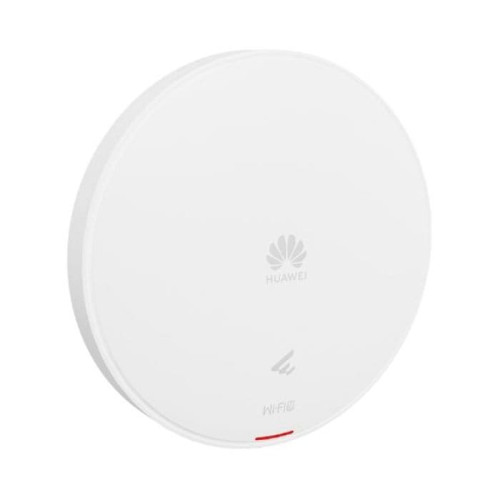
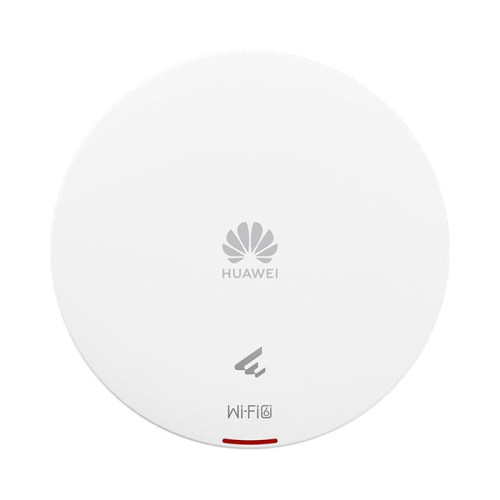
AP661 Huawei eKit Product Specification |
Product Overview | Huawei eKit AP661 Wireless Access Point 802.11ax Tri-Radio 2/5/5GHz 4x4 MIMO, 6.575Gbps Dual-radio Smart antenna, Port 2.5G รองรับการ Managed ผ่าน Cloud/Stanalone |
Technical specifications |
Installation Type | Wall,Ceiling,T-Rail |
Dimensions (Diameter x Height) | 220 mm x 50 mm |
Weight | 1.08 kg |
LED indicator | Indicates the power-on, startup, running, alarm, and fault states of the system. |
Maximum power consumption [W] | 21.2 W (excluding USB) |
Power supply mode | DC adapter,PoE |
Rated input voltage [V] | 12 V |
Input voltage range [V] | DC: 12 V ± 10% PoE: 802.3at/af |
Service port surge protection [kV] | PoE port: Common mode (8 wires to ground): 4 kV (1.2/50 us, 42 ohms), criterion B Differential mode (48 V-RTN): 0.5 kV (1.2/50 us, 42 ohms), criterion B |
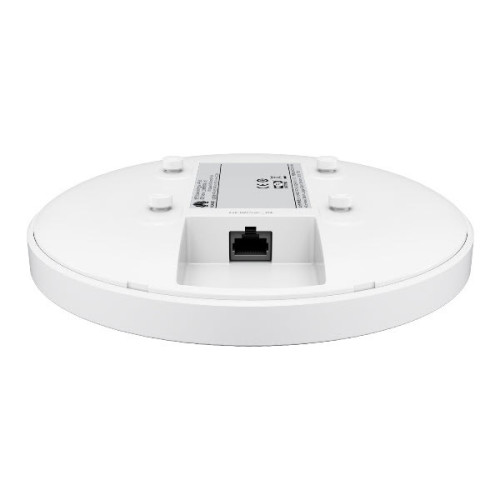
Physical ports on the entire device | 1 x 10M/100M/GE/2.5GE electrical port
1 x 10M/100M/GE electrical port |
Bluetooth (BLE) | BLE 5.2 |
Operating temperature | -10°C to +50°C |
Storage temperature | -40°C to +70°C |
Radio specifications |
Radio number | 2 |
Operating frequency band | 2.4GHz,5GHz |
MIMO spatial streams | Radio 0 (2.4 GHz): 2x2
Radio 1 (5 GHz): 2x2
Radio 2 (5 GHz): 4x4 |
Wi-Fi standard | 2.4 GHz: 802.11b/g/n/ax
5 GHz: 802.11a/n/ac/ac Wave 2/ax |
Antenna type | Built-in smart antennas |
Antenna gain | 2.4 GHz: 4 dBi
5 GHz: 5 dBi |
Maximum transmit power | 2.4 GHz: 25 dBm (combined power)
5 GHz (2x2 MIMO): 23 dBm (combined power)
5 GHz (4x4 MIMO): 26 dBm (combined power) |
Maximum number of SSIDs for each radio | 16 |
Maximum number of users | ≤ 1536 (512/radio)
NOTE: The actual number of users varies according to the environment. |
Cloud-based management mode |
WLAN features | Compliance with IEEE 802.11ax and compatibility with IEEE 802.11a/b/g/n/ac/ac Wave 2
Maximum ratio combining (MRC)
Space time block code (STBC)
Cyclic Delay Diversity (CDD)/Cyclic Shift Diversity (CSD)
Beamforming
Multi-user multiple-input multiple-output (MU-MIMO)
Orthogonal frequency division multiple access (OFDMA)
Compliance with 1024-quadrature amplitude modulation (QAM) and compatibility with 256-QAM, 64-QAM, 16-QAM, 8-QAM, quadrature phase shift keying (QPSK), and binary phase shift keying (BPSK)
Target wake time (TWT)
Low-density parity-check (LDPC)
Frame aggregation, including A-MPDU (Tx/Rx) and A-MSDU (Tx/Rx)
802.11 dynamic frequency selection (DFS)
Priority mapping and scheduling that are compliant with Wi-Fi multimedia (WMM) to implement priority-based data processing and forwarding
Automatic and manual rate adjustment (the rate is adjusted automatically by default)
WLAN channel management and channel rate adjustment
NOTE
For detailed management channels, see the Country Codes & Channels Compliance.
Automatic channel scanning and interference avoidance
Service set identifier (SSID) hiding
Signal sustain technology (SST)
Unscheduled automatic power save delivery (U-APSD) |
Network features | Compliance with IEEE 802.3ab
Auto-negotiation of the rate and duplex mode and automatic switchover between the Media Dependent Interface (MDI) and Media Dependent Interface Crossover (MDI-X)
Compliance with IEEE 802.1q
SSID-based VLAN assignment
DHCP client, obtaining IP addresses through DHCP
STA isolation in the same VLAN
Access control lists (ACLs)
Unified authentication on the Cloud management platform
Network Address Translation (NAT) |
QoS features | Priority mapping and scheduling that are compliant with WMM to implement priority-based data processing and forwarding
WMM parameter management for each radio
WMM power saving
Priority mapping for upstream packets and flow-based mapping for downstream packets
Queue mapping and scheduling
User-based bandwidth limiting
Airtime scheduling
Air interface HQoS scheduling |
Security features | Open system authentication
WEP authentication/encryption using a 64-bit, 128-bit, 152-bit or 192-bit encryption key
WPA2-PSK authentication and encryption (WPA2-Personal)
WPA2-802.1X authentication and encryption (WPA2-Enterprise)
WPA3-SAE authentication and encryption (WPA3-Personal)
WPA3-802.1X authentication and encryption (WPA3- Personal)
WPA-WPA2 hybrid authentication
WPA2-WPA3 hybrid authentication
802.1X authentication, MAC address authentication, and Portal authentication
DHCP snooping
Dynamic ARP Inspection (DAI)
IP Source Guard (IPSG) |
Maintenance features | Unified management and maintenance on the Cloud management platform
Automatic login and configuration loading, and plug-and-play (PnP)
Batch upgrade
Telnet
STelnet using SSHv2
SFTP using SSHv2
Web-based local AP management through HTTP or HTTPS
Real-time configuration monitoring and fast fault locating using the NMS
System status alarm
Network Time Protocol (NTP) |